
In Delhi :- Red Fort, Qutub Minar, Humayun's Tomb, and India Gate.
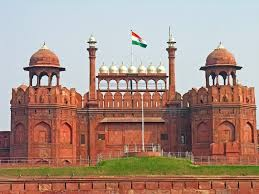
Red Fort (Lal Qila)
History: The Red Fort was built by the Mughal Emperor Shah Jahan as the palace fort of his new capital, Shahjahanabad (now Old Delhi). Its construction began in 1639 and was completed in 1648. It served as the main residence of the Mughal emperors for nearly 200 years.
Architecture: The fort is named for its massive enclosing walls of red sandstone. It is an irregular octagon with two main gates: the Lahori Gate and the Delhi Gate. The design of the Red Fort is a culmination of Mughal creativity, blending Persian, Timurid, and Hindu traditions. The interior includes several exquisite palaces and halls, such as the Diwan-i-Aam (Hall of Public Audience) and the Diwan-i-Khas (Hall of Private Audience), as well as a continuous water channel known as the Nahr-i-Behisht (Stream of Paradise). The fort is also the site where the Prime Minister of India addresses the nation on Independence Day.
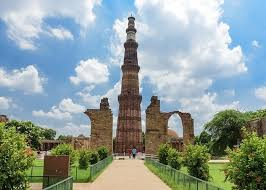
Qutub Minar
History: The Qutub Minar is a towering minaret and a UNESCO World Heritage Site. Its construction was started in 1192 by Qutb-ud-din Aibak, the first ruler of the Delhi Sultanate, and was completed by his successor Iltutmish. It was built as a victory tower to celebrate the Muslim conquest of Delhi and also served as a minaret for the adjacent Quwwat-ul-Islam Mosque.
Architecture: The 73-meter-high minaret is made of red sandstone and marble and is a blend of Indo-Islamic architecture. It has five distinct stories, each marked by a projecting balcony. The tower tapers from a diameter of 14.3 meters at the base to 2.7 meters at the top. The intricate carvings and inscriptions from the Quran add to its beauty. The complex also includes the Quwwat-ul-Islam Mosque, the tomb of Iltutmish, and the famous Iron Pillar of Delhi, which has not rusted for over 1,600 years.
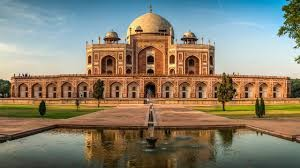
Humayun’s Tomb
History: This magnificent tomb was commissioned in 1569 by Humayun’s first wife and chief consort, Empress Bega Begum, nine years after his death. It was designed by the Persian architect Mirak Mirza Ghiyas. It is considered a precursor to the Taj Mahal.
Architecture: Humayun’s Tomb is the first garden-tomb on the Indian subcontinent and is a UNESCO World Heritage Site. It’s renowned for its use of red sandstone and white marble and its innovative design. The tomb is the centerpiece of a Charbagh (four-quartered paradise garden), with waterways and walkways. The mausoleum itself is a grand structure with a double dome, which was a new architectural feature at the time. The complex also houses the graves of other notable Mughal figures, earning it the nickname “the necropolis of the Mughal dynasty.”
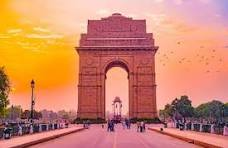
India Gate
History: India Gate is a war memorial located in the heart of New Delhi. Designed by Sir Edwin Lutyens, it was built to commemorate the 70,000 Indian soldiers who lost their lives fighting for the British Army during World War I. The foundation stone was laid in 1921, and it was inaugurated in 1931.
Architecture: The 42-meter-high archway is inspired by the Arc de Triomphe in Paris. The names of more than 13,500 British and Indian soldiers killed in the Third Anglo-Afghan War are inscribed on the memorial. Since 1971, the Amar Jawan Jyoti, or the “flame of the immortal soldier,” has burned continuously under the arch, as a tribute to the Indian soldiers who laid down their lives in the Indo-Pakistan War. The monument stands on a low base of red Bharatpur stone and is a symbol of national pride.
