

Best Tourist Places in Bihar
Bihar is a land of rich history, spirituality, and natural beauty.
From ancient universities to peaceful temples and wildlife sanctuaries, Bihar offers unforgettable travel experiences.
1. Bodh Gaya
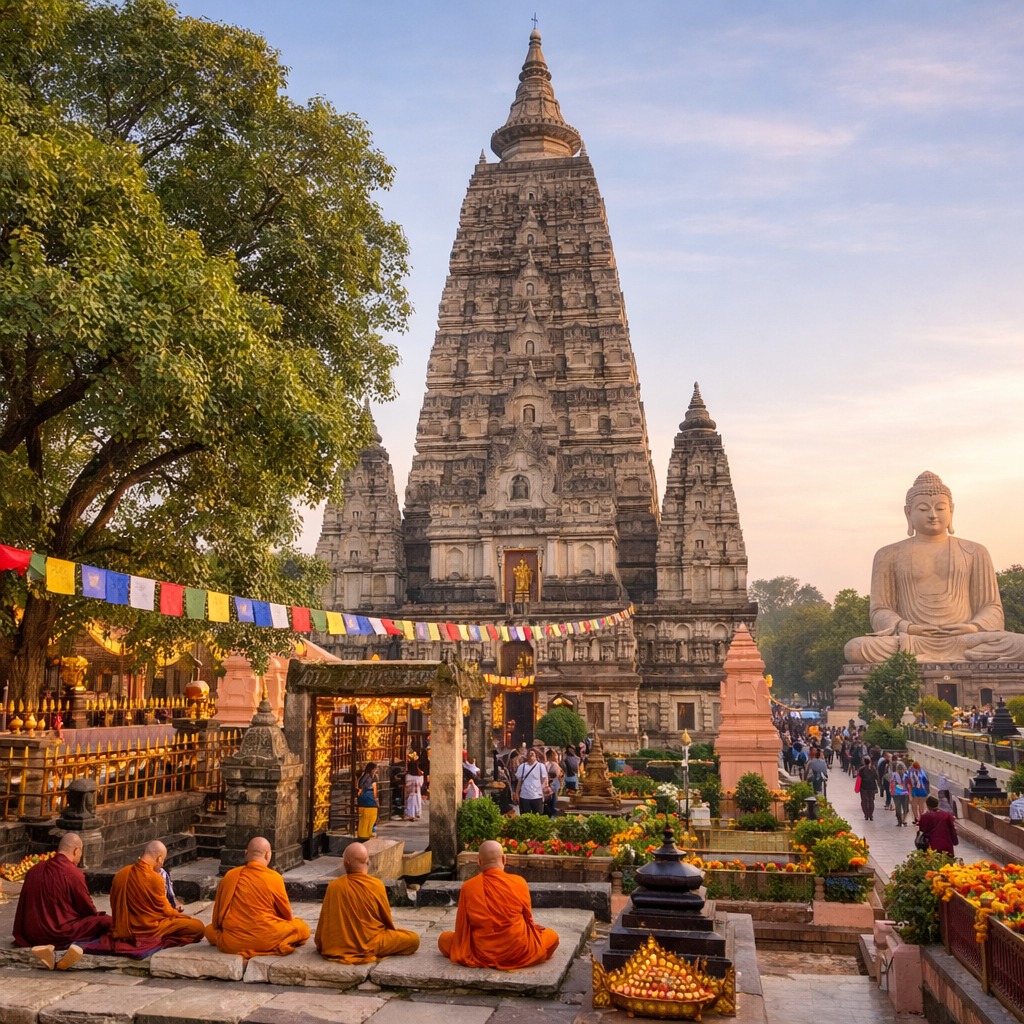
Bodh Gaya is one of the most sacred Buddhist pilgrimage destinations in the world. It is the place where Gautama Buddha attained enlightenment under the Bodhi Tree.
Main Attraction: Mahabodhi Temple (UNESCO World Heritage Site)
Best For: Spiritual seekers & international tourists
Apart from its spiritual importance, Bodh Gaya offers visitors a chance to explore local culture. The markets around the temple sell handicrafts, prayer beads, Tibetan items, and souvenirs. Traditional Bihari cuisine and international food options are easily available due to the global visitors.
:- Historical Significance
The history of Bodh Gaya dates back to the 6th century BCE. Prince Siddhartha, who later became Gautama Buddha, left his royal life in search of truth and liberation from suffering. After years of meditation and spiritual practice, he finally attained enlightenment under the sacred Bodhi Tree in Bodh Gaya. From that moment, he became the “Buddha,” meaning “The Awakened One.”
This event transformed Bodh Gaya into the most important pilgrimage site for Buddhists worldwide. Over centuries, kings and devotees built temples, monasteries, and stupas around this sacred spot. The great Mauryan emperor Ashoka visited Bodh Gaya in the 3rd century BCE and constructed the first temple here to honor Buddha’s enlightenment.
Mahabodhi Temple – A UNESCO World Heritage Site
The most iconic attraction of Bodh Gaya is the magnificent Mahabodhi Temple. This temple complex marks the exact location where Buddha attained enlightenment.
Built in the 5th–6th century CE, the temple stands about 55 meters tall and features beautiful ancient Indian architecture. The temple’s pyramidal structure, intricate carvings, and peaceful surroundings create a divine atmosphere. In 2002, the Mahabodhi Temple Complex was declared a UNESCO World Heritage Site, recognizing its historical and spiritual importance.
Inside the temple, a large statue of Buddha in a meditation posture attracts devotees who sit in silence and prayer. Behind the temple stands the sacred Bodhi Tree, believed to be a direct descendant of the original tree under which Buddha meditated.
The Sacred Bodhi Tree
The Bodhi Tree is the spiritual heart of Bodh Gaya. It represents wisdom, peace, and awakening. Pilgrims from countries such as Thailand, Sri Lanka, Japan, Myanmar, and Tibet come here to meditate under its shade. The calm environment, the chanting of monks, and the ringing of prayer bells create a deeply spiritual experience.
Many visitors describe sitting near the Bodhi Tree as life-changing. Whether religious or not, people feel a sense of calmness and clarity here.
2. Nalanda
Nalanda is one of the most important historical and educational sites in the world.
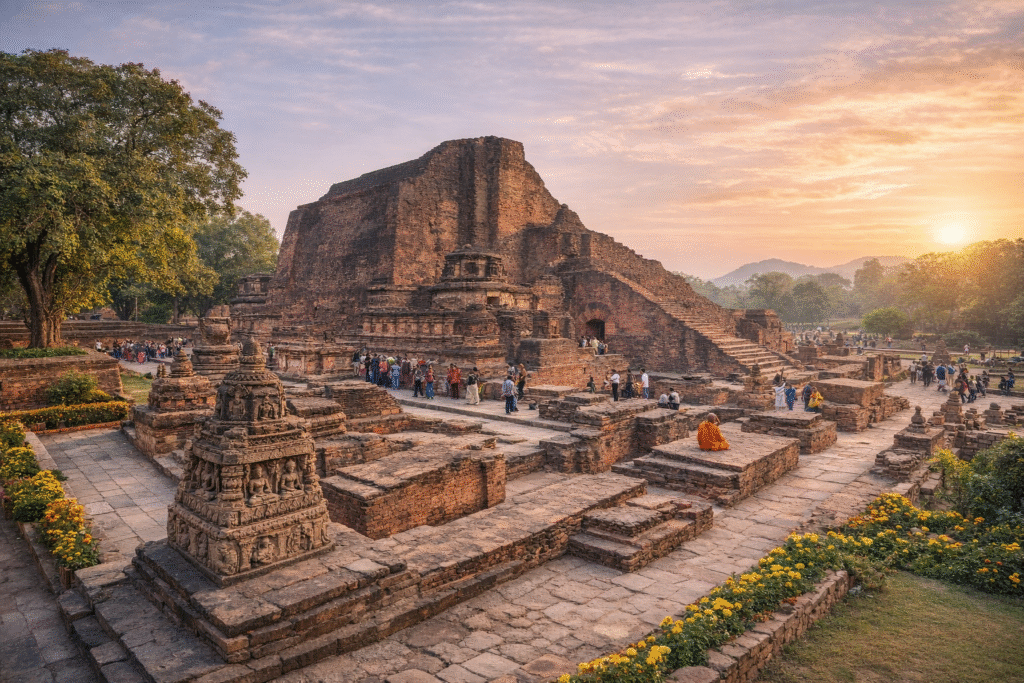
It is famous for the ruins of Nalanda University, which was established in the 5th century CE during the Gupta period. It is considered the world’s first residential university, attracting students and scholars from countries like China, Korea, Tibet, and Sri Lanka.
Historical Background
Nalanda University was established in the 5th century CE during the reign of the Gupta Empire, often referred to as the Golden Age of India. Although some historical references suggest earlier educational activity in the region, it was during the Gupta period that Nalanda developed into a large and organized university.
The name “Nalanda” is believed to mean “giver of knowledge.” True to its name, the university became one of the greatest centers of higher learning in the ancient world. Kings and rulers generously supported the institution, donating land, wealth, and resources to ensure its growth and sustainability.
One of the most famous rulers who contributed to Nalanda was Emperor Harsha in the 7th century. Under his patronage, the university flourished even more and gained international recognition.
Academic Excellence and Subjects Taught
Nalanda University was far ahead of its time. It was the world’s first fully residential university, with large dormitories, classrooms, meditation halls, temples, and libraries within a well-planned campus.
At its peak, Nalanda had:
Around 10,000 students
Nearly 2,000 teachers and scholars
A vast campus spread across many acres
Admission to Nalanda was highly competitive. Students had to pass difficult entrance examinations conducted by learned scholars. Only the most talented and dedicated students were admitted.
The subjects taught at Nalanda were diverse and advanced. They included:
Buddhist philosophy
Logic and grammar
Astronomy and mathematics
Medicine and surgery
Architecture
Political science
Vedic studies
This wide range of subjects made Nalanda a complete center of multidisciplinary education. It was not limited to religious studies; instead, it promoted scientific thinking, debate, and intellectual growth.
International Recognition
Nalanda was truly an international university. Students came from various countries such as China, Korea, Japan, Tibet, Mongolia, Sri Lanka, and Southeast Asia.
One of the most famous visitors was the Chinese scholar Xuanzang (Hiuen Tsang), who studied and taught at Nalanda in the 7th century. His writings provide detailed descriptions of the university’s structure, academic standards, and daily life. According to him, Nalanda was a place of disciplined learning, deep discussions, and scholarly debates.
Another Chinese traveler, Yijing, also documented the excellence of Nalanda and praised its high academic standards.
Because of these global connections, Nalanda became a bridge between India and other Asian civilizations. Knowledge traveled from India to East Asia through scholars trained at Nalanda.
The Great Library – Dharmaganja
One of the most extraordinary features of Nalanda University was its massive library known as “Dharmaganja,” meaning “Treasury of Truth.” The library had three large buildings, each filled with thousands of manuscripts and texts.
It is believed that the library stored books on philosophy, science, medicine, religion, astronomy, and many other subjects. Scholars from different regions contributed to and copied these manuscripts.
The library was so vast that when the university was destroyed in the 12th century, historical accounts say the books continued burning for several months.
Architecture and Campus Design
The ruins of Nalanda reveal an advanced and well-organized campus layout. The university had:
Large red-brick monasteries
Temples and stupas
Lecture halls
Residential quarters
Gardens and water tanks
The architecture reflects Gupta-era design with beautiful carvings and artistic decorations. The main temple structure rises prominently above the ruins, showcasing intricate brickwork and stone sculptures.
The campus was built systematically, with monasteries arranged in rows and temples facing them. This organized design indicates careful planning and advanced urban architecture for its time.
Decline and Destruction
Nalanda flourished for nearly 700 years. However, in the 12th century, it faced destruction during the invasion of Bakhtiyar Khilji. The university was burned, monks were killed or forced to flee, and its vast library was destroyed.
This tragic event marked the end of one of the greatest educational institutions in ancient history. The destruction of Nalanda was not just the loss of buildings but the loss of centuries of accumulated knowledge.
Despite its destruction, Nalanda’s legacy survived through the writings of travelers and the spread of Buddhist teachings across Asia.
Rediscovery and UNESCO Recognition
For centuries, Nalanda remained buried under the earth. In the 19th century, archaeological excavations led by British scholars rediscovered the ruins
.
Today, the site is preserved and maintained by the Archaeological Survey of India. In 2016, Nalanda Mahavihara (the ancient university site) was declared a UNESCO World Heritage Site, recognizing its global historical significance.
Visitors can now walk through the ancient corridors, monasteries, and temples and imagine the intellectual life that once flourished here.
Modern Revival of Nalanda
Inspired by its glorious past, a new Nalanda University has been established near the ancient site. This modern institution aims to revive the spirit of global learning and international cooperation that once defined ancient Nalanda.
The new university focuses on sustainable development, historical studies, ecology, and international relations, reflecting both ancient wisdom and modern needs.
Tourism and Visitor Experience
Nalanda is a major tourist destination in Bihar. History lovers, researchers, students, and international visitors come to explore the ruins.
Nearby attractions include:
Rajgir
Bodh Gaya
These destinations together form an important Buddhist and historical tourism circuit.
The best time to visit Nalanda is between October and March when the weather is pleasant. Visitors can explore the ruins, visit the Nalanda Archaeological Museum, and learn about ancient Indian education.
Cultural and Educational Legacy
Nalanda symbolizes India’s ancient tradition of knowledge, debate, and intellectual freedom. It was a place where students from different cultures lived together, studied together, and exchanged ideas peacefully.
The university promoted values such as:
Discipline
Open discussion
Respect for knowledge
Global cooperation
Nalanda proved that education can unite nations and cultures.
Why Nalanda is Important Today
In today’s world, where education is rapidly changing, Nalanda stands as a reminder of the power of knowledge and international collaboration. It shows that India was once a global center of higher education long before many modern universities were established.
Nalanda represents:
Academic excellence
Cultural unity
Historical pride
Intellectual freedom
Its story inspires students, scholars, and nations to value education as the foundation of progress.
Conclusion
Nalanda is more than just an archaeological site; it is a symbol of human curiosity, learning, and civilization. The ruins of Nalanda University remind us of a time when knowledge was respected as the highest treasure.
From its grand libraries and international scholars to its tragic destruction and modern revival, Nalanda’s journey is both inspiring and emotional. It stands as a proud chapter in India’s history and a shining example of the world’s ancient educational heritage.
For anyone interested in history, culture, or education, Nalanda is not just a place to visit—it is a story to experience.
